 PERSONAL PROTOTYPE
What I’m doing in this video
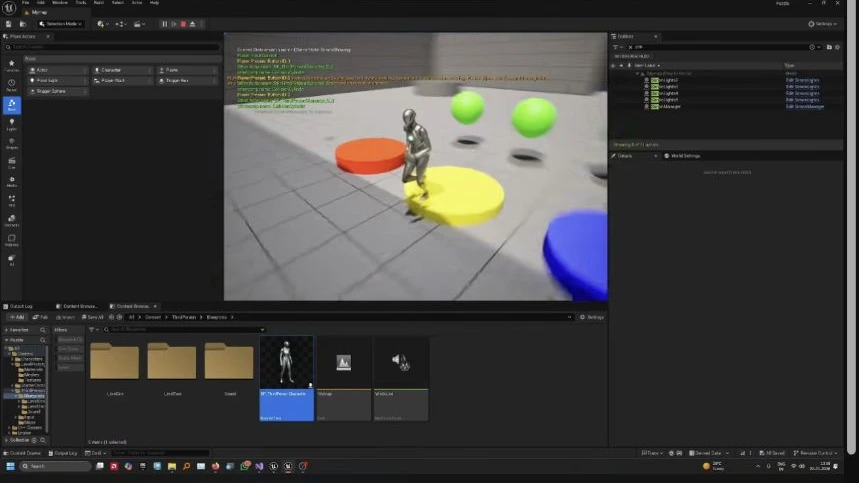
I demonstrate two puzzle levels and explain how their gameplay logic works. Choose a timestamp to watch that part.
I start the puzzle and repeat the light sequence by stepping on the coloured buttons. The sequence grows up to the configured length.
I show how the manager starts the puzzle, generates a random sequence, moves through states and waits for player input.
I explain the button movement, button IDs, material changes and how the buttons and lights communicate through the manager.
I demonstrate the two levers that control the platform along two axes. Hitting an obstacle resets the attempt.
I show why the moving obstacles are difficult at normal speed, then use slow motion to create more time to react.
I open the Blueprint setup: global dilation switches between 0.1 and 1, while the character and platform use custom dilation of 10 or 1 to compensate.
I show editor controls for movement axis, range, speed and phase offset, so instances can move differently.
I explain the saved reset target and collision-triggered teleport. At the end, I discuss using LLM assistance and manually correcting unstable logic.
A Simon Says sequence and a moving-platform maze, exploring game states, player feedback, and control over time.
Simon Says: one manager, clear roles
The manager generates a random sequence, directs the lights and checks the player’s input. Buttons report back to it through overlap events. Depressing the buttons and switching light materials give the player visible feedback. Sequence length and timing can be adjusted.
The maze: making time work for the player
Two levers steer a platform through moving obstacles. Slow motion gives the player more time to react: global time dilation slows the environment, while custom time dilation compensates for the character and platform. Obstacle speed, movement range, axis and phase offset can be adjusted in the editor.
Iteration and debugging
Collisions reset the platform to an editor-defined target. I used LLM assistance for parts of the puzzle logic, then corrected unstable behaviour manually and tested the result in the level.